
When “Effectively Zero” Still Sounds Like a Warning
Rethinking risk language, threat framing, and why HIV communication still struggles to reflect the certainty of U=U


Over the past several months, I have been watching something interesting begin to unfold.
Organizations are reaching out to say they are reviewing and updating the language they use when talking about U=U. Conversations are happening about wording, framing, and whether some of the phrases we have relied on for years still reflect the science as clearly as they should.
That response tells me this conversation was overdue.
Because even now, long after the science behind U=U was settled, we continue to communicate about HIV through the language of risk and threat. Sometimes subtly. Sometimes directly. Often without even realizing it.
A recent example appeared in a social media post that stated the “risk is effectively zero” for people living with HIV who maintain an undetectable viral load.
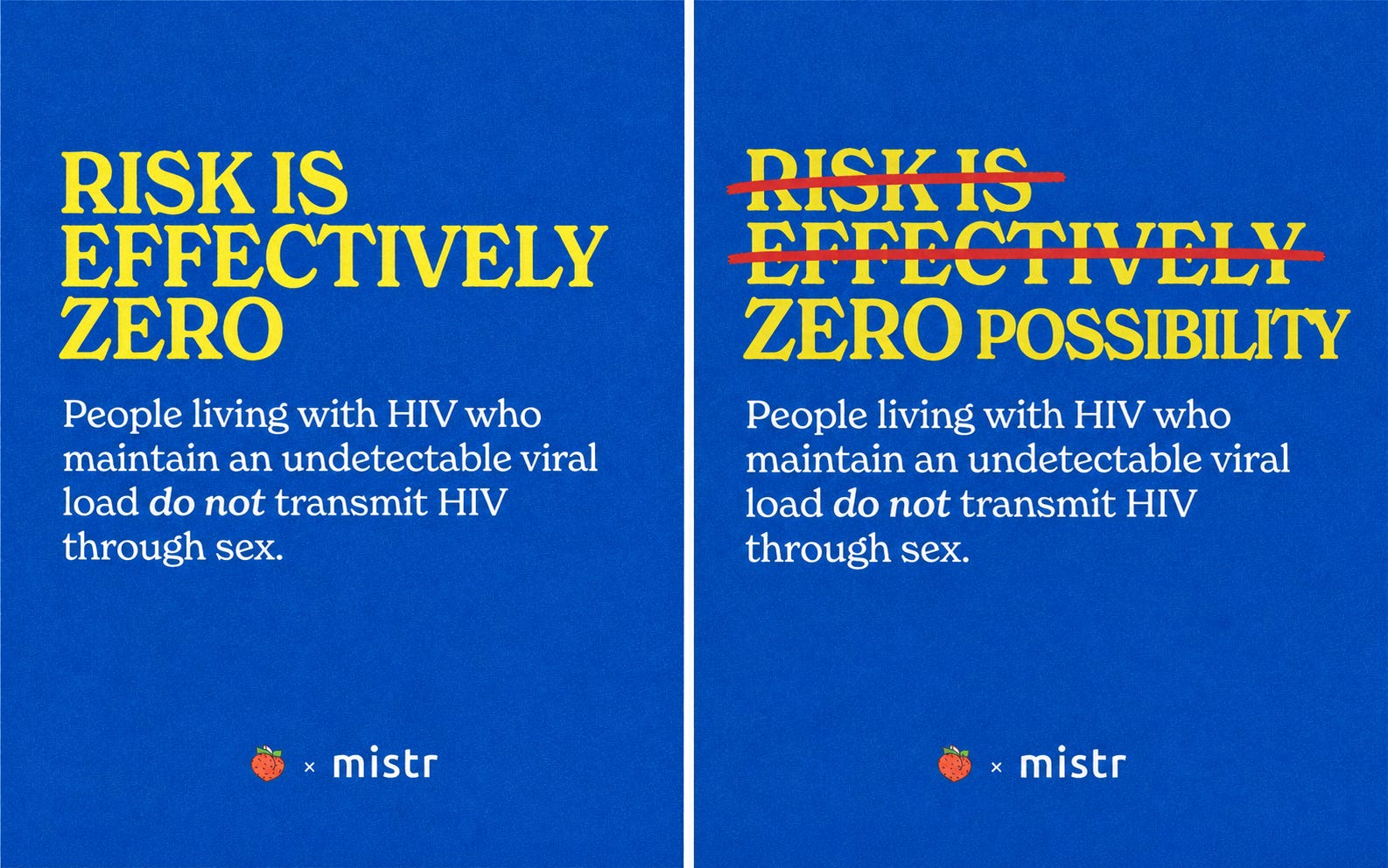
The intention behind messaging like this is good. It is trying to reassure. It is trying to reduce fear. It is trying to communicate the extraordinary reality of U=U to broad audiences in language they may already understand.
But intention and impact are not always the same thing.
When we say “effectively zero,” the conversation remains anchored in risk. HIV is still positioned as something dangerous that must be carefully managed, monitored, or tolerated. The frame itself does not change. The only thing that changes is the degree of perceived danger.
That matters more than many people realize.
U=U did not show that HIV transmission becomes very unlikely when someone is undetectable. It demonstrated that HIV is not sexually transmitted when viral load is undetectable. That distinction is not semantic. It is foundational.
There is a profound difference between reducing risk and removing transmission.
When someone hears “effectively zero,” many will still hear “not quite zero.” They hear a qualifier. A caveat. A subtle warning not to trust completely. The language leaves space for fear to survive even after the science has removed the basis for it.
And once fear remains in the frame, stigma remains close behind.
This is the same problem that appears when HIV continues to be described as a “public health threat.”
At one time, that framing reflected reality. Before effective treatment existed, HIV was devastating communities across the globe. Public health systems responded through emergency language because the crisis demanded it.
But language developed during periods of crisis has a way of outliving the conditions that created it.
Today, HIV is a manageable chronic condition for people with access to testing, treatment, and care. U=U has fundamentally transformed what we know about sexual transmission. Yet despite this, HIV is still frequently discussed using the vocabulary of danger, threat, and containment.
Words matter because framing shapes perception.
When HIV is repeatedly positioned as a threat, people living with HIV continue to be viewed through the lens of potential harm. That framing influences healthcare interactions, disclosure expectations, criminalization discussions, public policy, media reporting, and personal relationships.
Even well intentioned language can reinforce that architecture.
That does not mean people communicating about U=U are acting maliciously. In many cases, they are trying to move audiences toward acceptance carefully and responsibly. But careful language can become overly cautious language. And overly cautious language can unintentionally preserve the very stigma it is trying to dismantle.
This is where HIV communication now faces an important challenge.
Are we communicating from the certainty of the science, or are we still communicating from residual fear.
Because those are not the same thing.
U=U is not fragile science that requires constant hedging in order to remain credible. It does not become more trustworthy because we soften it with qualifiers like “effectively.” If anything, the continued need to cushion the message suggests lingering discomfort with fully accepting what the evidence tells us.
And the evidence is clear.
When a person living with HIV is on treatment and maintains an undetectable viral load, HIV is not sexually transmitted.
Not rarely.
Not almost never.
Not effectively zero.
Not transmitted.
That certainty matters because implementation depends on trust. If healthcare systems, policymakers, organizations, and communities continue to communicate U=U through language rooted in caution and threat, full integration will always remain incomplete. U=U becomes something people are encouraged to cautiously acknowledge rather than something systems fully operationalize.
This conversation is not about policing language or criticizing organizations trying to do the right thing. It is about asking whether our words still reflect the reality we claim to believe in.
And if they do not, what does that say about the work still left to do.
It is also important to say this clearly. U=U is not a measure of worth, compliance, or personal value. Not everyone living with HIV is able to attain or maintain an undetectable viral load, often because of barriers tied to access, housing, mental health, side effects, poverty, criminalization, or unequal healthcare systems. The certainty of U=U should never be weaponized to divide communities or create hierarchies of dignity among people living with HIV.
But acknowledging those realities does not require us to weaken the science where certainty exists.
It requires us to communicate more precisely, more compassionately, and with greater awareness of how language shapes stigma.
The next phase of HIV advocacy is not simply ensuring people know about U=U.
This is also why initiatives like U=U University’s Understanding and Communicating U=U course matter so deeply. The course does more than explain the science of U=U. It challenges participants to think critically about communication, implementation, stigma, and the responsibility we carry when translating evidence into public understanding. If our language has not fully caught up with the science, education spaces like these are part of how that begins to change.
It is ensuring we finally learn how to speak about U=U with the same level of confidence the science already deserves.
The science has moved on.
Our language needs to follow.
Author’s Note
This reflection is offered with respect for the organizations, educators, healthcare providers, advocates, and campaigns working every day to communicate U=U more widely and effectively. Conversations about language are not about assigning blame. They are about growth, reflection, and ensuring that our communication evolves alongside the science itself. I believe most people using phrases like “effectively zero” are acting from care and responsibility. The question this piece asks is whether those words still serve us as well as they once did, or whether they unintentionally keep HIV framed through fear long after the science has moved beyond it.